
Pocket Ants: Colony Simulator
Ariel-GamesStrategy
4.312.94K Reviews
- Version
- 0.1153
- Installs
- 10.00M
- Age Rating
- Everyone
Screenshots
Our Review of Pocket Ants: Colony Simulator
 Analysis by Appyee
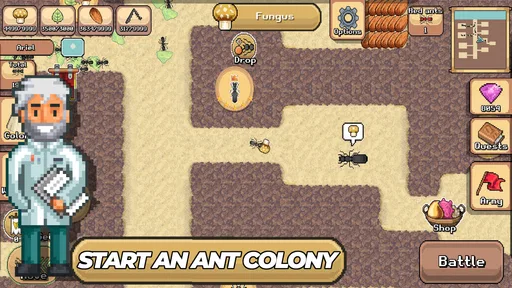
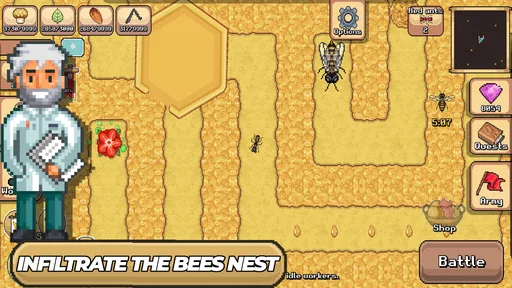
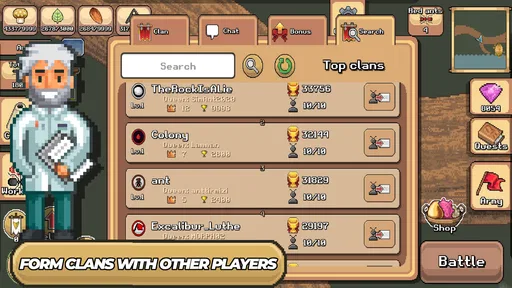
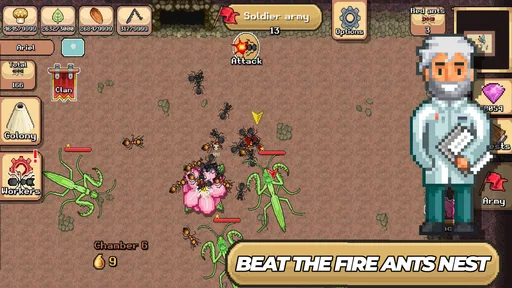
Some strategy games ask me to think in terms of kingdoms, armies, or cities. Pocket Ants: Colony Simulator makes the same kind of planning feel much closer to the ground. I guide a small insect colony, gather what it needs, strengthen the nest, build an army, and decide when to risk a raid. The scale is tiny, but the choices are surprisingly easy to understand: every improvement should help the colony survive the next problem, not merely make a number look bigger.
I spent time with it as a casual strategy game rather than treating it like a fast action title. That distinction matters. The best moments come from choosing what to do next, watching a plan work, and accepting that a poorly timed attack can set progress back. It is free to play, rated for Everyone, and developed by Ariel-Games. Its current version is 0.1153, and it runs on devices using Android 7.1 or later.
The game has clearly found a large audience, with an average rating of 4.3 from around 335,000 ratings and more than 10 million installs. Those figures do not replace personal experience, but they fit my impression: this is an approachable colony strategy game with a simple premise and enough room for careful players to create their own routines.
Small colony, meaningful decisions
I like how this section frames the colony as a series of choices rather than a checklist of upgrades. It also points toward a useful question for anyone deciding whether to keep playing: does the game’s steady pace leave room to change plans, or does it eventually make every session feel alike?
Planning what the nest needs first
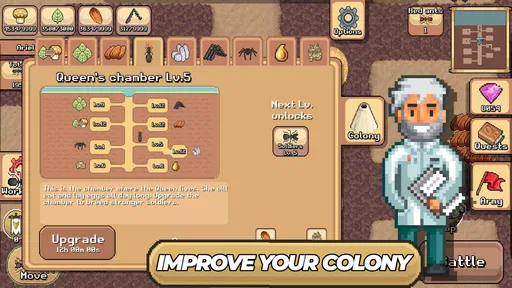
The central decision is not simply whether to collect resources. It is deciding which need deserves attention now. Improving the nest may make future growth easier, while building an army prepares me for conflict. Raiding another colony can bring useful rewards, but it also asks me to commit strength that might otherwise protect my own position. I found that the game becomes more interesting when I stop treating every available upgrade as equally urgent.
My preferred approach was to establish a stable rhythm before becoming aggressive. I gathered enough to make the colony feel secure, invested in improvements that supported continued progress, and only then looked for a worthwhile target. This is not a complicated economic simulation, but it does create a useful planning horizon. I am constantly asking whether a short-term gain will leave me better prepared a few minutes later.
That makes the game a good fit for players who enjoy light management without wanting a dense spreadsheet. The controls and goals are easy to grasp, yet the order of actions still matters. A player who spends everything immediately may find the next obstacle more uncomfortable than someone who keeps a reserve and waits for a better opportunity.
Why the army is more than an upgrade button
Building an army is tempting because it gives the colony a clear sense of momentum. However, I learned not to read military growth as automatic permission to attack. A larger force is useful only when it is connected to a sensible objective. If I raid merely because I can, I may gain something quickly while losing the flexibility to respond to the next threat.
This is one of the more valuable lessons in the game: strength is useful, but timing turns strength into progress. I get better results when I think about the purpose of each military investment. Am I trying to secure resources, test my readiness, or push the colony into a stronger phase? Asking that question keeps the game from becoming a repetitive cycle of collecting and spending.
Players who enjoy direct tactical control may find the strategy relatively light compared with more elaborate war games. Pocket Ants is not trying to reproduce a large battlefield with numerous layers of command. Its appeal comes from compressing the same ideas into a colony-sized loop that is easier to revisit during a short session.
How I decide whether a raid is worth it
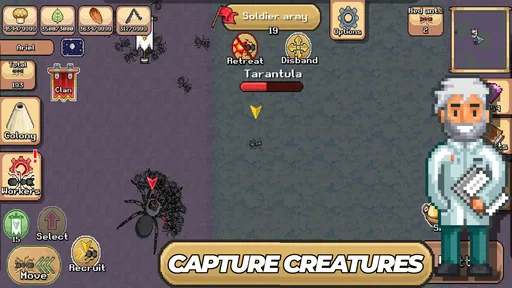
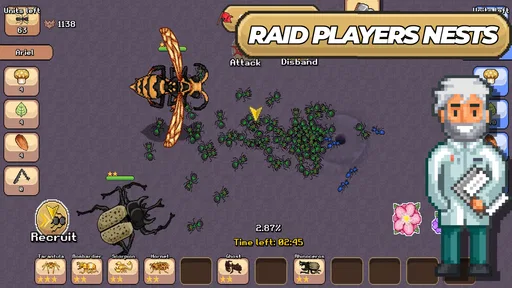
Raiding is where the game’s risk-and-reward character becomes clearest. The attraction is immediate: another colony represents an opportunity to accelerate my development instead of waiting for ordinary gathering. The danger is equally understandable. A failed or badly timed raid can consume effort, weaken my position, and force me to rebuild the momentum I thought I had secured.
I started treating each raid as an investment rather than a guaranteed payout. Before committing, I consider whether my colony can tolerate a setback. If the answer is no, I continue gathering and improving instead of chasing a tempting target. This approach is slower, but it produces fewer frustrating reversals. It also gives successful raids more meaning because they feel earned through preparation rather than random impatience.
A practical everyday scenario shows why this works. If I have only a few minutes before leaving home, I do not begin a risky offensive that needs careful follow-through. I use that session to collect resources or make a modest improvement, then return later with a clearer plan. When I have more time, I can prepare the army, check the colony’s position, and make the raid part of a larger sequence. The game suits this flexible rhythm better than a strategy title that demands uninterrupted attention.
Adapting instead of repeating the same opening
One of my favorite aspects is the way a single preferred routine eventually becomes predictable. At first, I can follow a comfortable opening: gather, improve, recruit, and attack. After a while, that sequence stops feeling optimal in every situation. A colony that needs immediate development calls for different priorities from one that is already positioned for conflict.
This encourages adaptation without burying me under complicated rules. I can change the order of my actions, delay a raid, or redirect resources toward the nest when the current plan is no longer helping. The game rewards noticing when an approach has stopped working. That may sound obvious, but many casual strategy games let players repeat one successful pattern indefinitely. Here, repetition is useful for learning, yet it is not always the best long-term answer.
The trade-off is that the game’s depth comes more from sequencing and judgment than from a huge collection of systems. Players looking for detailed diplomacy, elaborate technology trees, or highly specialized units may find the experience too restrained. Players who prefer readable choices and a clear connection between preparation and outcome will probably appreciate that restraint.
Using short sessions without losing the bigger plan
Pocket Ants works well when I divide play into small objectives. One session can focus on gathering. Another can prepare the nest. A later visit can be dedicated to building enough military strength for a raid. This method prevents me from spending resources impulsively just because I have returned to the game.
The important habit is to leave myself a next step. I try not to end a session after scattering resources across unrelated improvements. Instead, I finish with a clear intention, such as building toward a stronger army or reaching a safer development point. That makes the next session feel connected to the previous one, even when I have only a short amount of time available.
This is also where the free-to-play structure deserves a realistic mention. The game can be played for free, while in-app purchases range from $0.99 to $99.99 per item. I would approach those purchases as optional convenience rather than part of the basic strategy. The most satisfying progress, in my experience, comes from making better decisions with the colony I already have. Anyone uncomfortable with optional spending should still pay attention to the purchase prompts and keep a personal limit.
What changes as the colony develops
Early progress feels direct because every resource has an obvious purpose. As the colony improves, the decisions become less about finding any upgrade and more about choosing the upgrade that supports the next stage of play. That shift gives the game a modest but genuine sense of depth over time.
I noticed that development changes how I evaluate risk. When the colony is fragile, preserving progress is usually more valuable than seeking a dramatic reward. Once the nest and army are in better shape, I can accept more uncertainty because a setback is less likely to erase everything I have built. The same raid can therefore look foolish early on and reasonable later, even if the basic objective has not changed.
This gradual change is the strongest reason to keep playing beyond the first impression. The premise is simple, but the player’s priorities evolve. I begin by asking how to grow. Later, I ask how to grow without exposing the colony, and how to turn a successful attack into lasting improvement rather than a brief spike in resources.
Counterplay: responding when the plan goes wrong
A good strategy game needs more than a winning plan; it needs a way to recover when the plan fails. Pocket Ants is most enjoyable when I treat mistakes as information. If an attack leaves me weaker than expected, the answer is not always to repeat it with a larger army. Sometimes the better response is to rebuild the resource base, strengthen the nest, and postpone aggression until the colony can absorb another risk.
This creates a useful form of counterplay at the player level. I am not only deciding how to win; I am deciding how to stop a bad decision from becoming a complete collapse. Keeping some resources uncommitted, avoiding unnecessary raids, and separating development goals are all ways to preserve options. These habits are not flashy features, but they are the difference between playing reactively and managing the colony with intention.
There is also a psychological trade-off. The game makes aggressive progress feel exciting, while cautious play can seem uneventful. Yet the quieter session often creates the foundation for the more rewarding one. I would recommend that new players resist the urge to measure every session by how much they gained immediately. A stable colony with several options is often in a better position than a richer colony that has exhausted its military strength.
Who will enjoy it, and who should skip it
I recommend this game to people who like strategy but want a compact, approachable format. It is especially suitable for players who enjoy gathering, gradual improvement, and deciding when to take a calculated risk. The insect-colony theme gives familiar management ideas a distinctive setting, and the small scale makes it easier to understand why one decision affects the next.
It is also a good choice for someone who wants a game that can be checked in short visits. I can set a modest goal, make progress, and stop without needing to complete a long campaign chapter. That flexibility makes it easier to fit around a commute, a break, or a quiet evening.
I would skip it if I wanted a deep competitive strategy game with extensive unit specialization, a complex political layer, or constant tactical action. It may also disappoint players who dislike waiting for resources, repeating collection routines, or managing optional purchase pressure in a free game. Those are not small details; they shape the experience. The game’s charm depends on enjoying a steady colony-building loop rather than expecting a full-scale strategy sandbox.
How it compares with familiar strategy alternatives
Compared with city-building games, Pocket Ants feels more focused because the colony and its army are closely connected. There is less distance between improving the home base and preparing for an attack. Compared with traditional war games, it is lighter and easier to enter, but it offers fewer layers for players who want long chains of specialized planning.
It also differs from purely idle colony games. I am not simply watching progress accumulate; I have to decide how much to gather, when to improve, and whether a raid is justified. At the same time, it does not demand the constant attention of a fast real-time battle game. That middle ground is its clearest identity: a strategy experience where planning matters, but the presentation remains accessible.
If I wanted a relaxing management game with a little danger, I would choose this over a heavier empire simulator. If I wanted highly detailed competitive warfare, I would choose a more specialized alternative instead. The right comparison depends on whether I value clarity and portability or maximum strategic complexity.
Practical advice before you commit
My first recommendation is to avoid spending every resource as soon as it becomes available. Keep enough flexibility to respond to an unexpected setback or to take advantage of a better opportunity. This simple reserve makes the colony feel much less fragile.
Second, build your army with a purpose. A military upgrade should support a planned raid or protect a development objective, not merely satisfy the feeling that a stronger number must always be better. When the army has a job, it becomes easier to judge whether the cost was worthwhile.
Third, use failed raids to adjust preparation rather than only increasing force. Ask whether the problem was timing, insufficient development, or an overly ambitious target. That diagnosis is more useful than blindly repeating the same attempt.
Finally, decide in advance how you will handle in-app purchases. The game is free, but individual purchases can range from $0.99 to $99.99. Setting a limit before playing keeps convenience spending from becoming part of every strategic decision.
My strategy verdict
Pocket Ants: Colony Simulator succeeds because it turns a familiar strategy loop into something personal and easy to read. I am not managing an abstract empire; I am trying to keep a small colony growing while deciding when it is ready to challenge another one. That scale makes the consequences understandable, and it gives ordinary choices—gather now, improve now, attack now—a satisfying amount of weight.
The game is not the right pick for players demanding enormous strategic complexity, but that is also why I find it approachable. Its depth comes from planning horizons, risk management, and adapting when a comfortable routine stops working. I can play cautiously, experiment with aggression, or build a session around one clear objective without feeling lost.
With its Everyone rating, free entry, broad device compatibility, and large established audience, it is easy to recommend as a low-pressure strategy game to try. My honest advice is to approach it patiently: protect your options, treat raids as calculated investments, and let the colony develop before chasing every reward. If that style of decision-making sounds more appealing than constant action, this small ant world has enough substance to keep your attention.
Verdict
Strengths of Pocket Ants: Colony Simulator
- Simple controls make the colony easy to manage on mobile.
- Many insect types add variety to exploration and battles.
- Short tasks suit quick gaming sessions.
- Collecting resources gives steady progress without complex menus.
- Unique ant-themed setting feels different from typical strategy games.
Limitations of Pocket Ants: Colony Simulator
- Energy and resource limits can slow progress between sessions.
- Some upgrades require considerable grinding to unlock.
- Combat may feel repetitive after extended play.
- Small text and icons can be difficult to read on smaller screens.
- Progress may feel less rewarding without regular online activity.
Similar Picks in This Category
View All
Clash of Clans
Supercell4.5

Plants vs. Zombies™
ELECTRONIC ARTS3.7

Lords Mobile: Kingdom Wars
IGG.COM4.5

Clash Royale
Supercell4.4

State.io — Conquer the World
CASUAL AZUR GAMES4.1

Car Driving School : Car Games
Spark Game Studios3.9
Frequently Asked Questions
What is Pocket Ants: Colony Simulator?
Pocket Ants: Colony Simulator is a real-time strategy and simulation game in which you control a growing ant colony. You gather food and resources, organize worker ants, attack or defend against other creatures, and expand your underground base. The game combines colony management, exploration, combat, and gradual upgrades in a compact mobile-friendly format.
How does gameplay work in Pocket Ants?
Gameplay revolves around collecting resources, improving your nest, and building a stronger colony over time. Your ants can gather food, carry materials, fight enemies, and help unlock new abilities or upgrades. You must plan where to send your units, protect important resources, and balance expansion with defense because hostile creatures and rival colonies can create pressure.
Can Pocket Ants: Colony Simulator be played offline?
Many of the main colony-management and exploration activities can generally be enjoyed without a constant internet connection, which makes the game suitable for short offline sessions. However, certain features may depend on connectivity, including advertisements, online events, updates, purchases, or other network-related services. Availability can also vary by device and game version.
Is Pocket Ants free to download and play?
Pocket Ants: Colony Simulator is typically available as a free download, allowing players to begin developing a colony without paying upfront. Like many mobile games, it may include optional in-app purchases and advertisements. These can provide convenience, bonuses, or other benefits, but the core progression is designed around playing, collecting resources, completing activities, and upgrading your colony.
Is Pocket Ants suitable for children and casual players?
The game is relatively easy to start because its central objectives—gathering resources, growing the nest, and improving ants—are straightforward. Nevertheless, progression may require patience, repeated resource collection, and occasional strategic decisions. Parents should review the store rating, advertising, and in-app purchase information for their region, while casual players should expect a gradual simulation rather than a fast, one-session experience.
Play our best games!


